
the cesi model
Social work is a profession committed to advancing the basic human needs of all people, especially those who are marginalized, oppressed, and living in poverty . As such, we are compelled to identify social problems and create solutions. The development of the Grand Challenges for Social Work has helped to galvanize our profession and focus our efforts on 13 broad social areas, that when addressed, help to promote our mission and advance human flourishing .
GRAND CHALLENGES FOR SOCIAL WORK

Ensure healthy development for all youth
Close the health gap
Build healthy relationships to end violence
Advance long and productive lives
individual and family well-being

stronger social fabric
Eradicate social isolation
End homelessness
Create social responses to a changing environment
Harness technology for social good

Just society
Eliminate racism
Promote smart decarceration
Build financial capability for all
Reduce extreme economic inequality
Achieve equal opportunity and justice
[1] National Association of Social Workers (2021). https://www.socialworkers.org/About/Ethics/Code-of-Ethics/Code-of-Ethics-English
[2] Barth, R., Messing, J., Shanks, T., and Herbert Williams, J. (2022) Grand Challenges for Social Work and Society. Oxford University Press
Since 2016 social work researchers and practitioners have engaged in numerous innovative projects to address the Grand Challenges. However, more progress is required. Social problems like racism and isolation tend to be persistent and evolve with societal changes. Technology is advancing rapidly which makes it increasingly difficult for social workers to prevent and respond to the myriad of ethical concerns that emerge with every technological advancement.
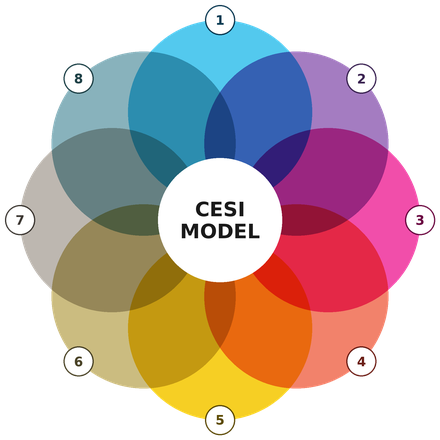
The Grand Challenges serve as an effective compass to direct our attention to society’s most pressing social problems. However, we have lacked a comprehensive framework to serve as the roadmap for developing sustainable solutions that are consistent with our professional values. The faculty of the Doctor of Social Work program at California Baptist University have sought to fill this gap by presenting a novel framework designed to help both new and seasoned social workers identify specific social problems and partner with communities to create socially innovative solutions. The Community Engagement and Social Innovation (CESI) Model (pronounced ses-see model) is an eight-phase framework to help us systematically tackle the Grand Challenges of Social Work. It incorporates best practices and literature from social work and other disciples (e.g. public health and public policy) that focus on community-based practice and research to present a novel method for identifying, collaborating, and innovating for social good. This webpage describes the CESI Model.
Phases of the CESI Model
-
Social work is a profession that places high value on self-awareness and self-reflection. Many of the theories that ground our professional practice (e.g. critical theory and constructivist approaches) emphasize the importance of investigating one’s own positionality in relation to society. As such, the CESI model starts with the process of critical self-reflection as an entry point to addressing societal problems. In the Observation phase scholars are asked to reflect on their own personal and professional experiences that have led them to an awareness of a social problem. In this first phase, scholars should think about the clients and communities they have served and ask themselves, what problems have I noticed? What causes these problems? What are the consequences of these problems going unaddressed? Not only are professional observations important to identify, but we all have personal experiences that cause us to become passionate about serving specific populations or addressing certain problems. Scholars are encouraged to think about their own lived experience, family background, trauma history, faith orientation, and other personal motivations for addressing the social problem they are most interested in.
-
After engaging in self-reflection related to societal problems, scholars should move to the next phase which is the identification of a specific social problem to tackle. Here, there are two key questions to consider, 1) does the observed phenomenon impede the flourishing and well-being of individuals, families, communities, and societies and 2) is the population most impacted by the phenomenon marginalized, vulnerable, or oppressed? If the answer to both of these questions is “yes” then the scholar should seek to further understand the social problem, its contributors, and consequences. In this phase, scholars need to hear directly from individuals and stakeholders who are most directly impacted by the social problem to get their perspectives on what the core problem is. It is also necessary to begin to familiarize oneself with the research literature, prevalence data, and policies that confirm that the observed phenomenon is a problem worth addressing. Questions should be answered like, what is known by scholars and practitioners about my specific social problem? How long has this social problem existed, and how has it evolved since its inception? Here is also where we ensure there is alignment between the social problem of interest, social work values, and Grand Challenges.
-
Social work practice should be values-oriented and theory-driven. Thus, the next phase of the CESI model involves developing a conceptual framework to help us explain the existence of the social problem. This framework also serves as a foundation for the development of solutions that seek to address the problem. It is recommended that scholars first start with a theological or worldview orientation to the problem. Worldviews encompass our conception of the world, expectations, and assumptions about the nature of the universe and the purpose and role of humanity. These perceptions influence all our thoughts and actions including our efforts to identify and address social problems. However, too often scholars do not explore the worldviews or make explicit the worldview that guides their understanding of the nature of the social problem they seek to address.
For Christians, it is imperative that we examine the Core Theological Concepts (CTC) that reveal God’s position on the problem of interest. To identify the CTC scholars must spend time reviewing theological literature, commentaries, and various perspectives from the rich global Christian tradition. In addition to a worldview examination scholars must also analyze the sociological theories that help us to understand the existence of social problems. After reflection on theory and theology scholars should attempt to develop their own conceptual model which is a visual depiction of the interconnected concepts that help illuminate the social problem.
-
The engagement phase is arguably the most critical phase of the CESI model. In fact, the model cannot work without intentional and sustained engagement with communities and stakeholders. First, we must define community. In this context, community is defined as the collection of individuals who are most directly impacted by the social problem. In other words these are the people who have the most to win or lose if the social problem does, or does not, get addressed. For a scholar who is interested in reducing homelessness among former foster youth the “community” they must engage are former foster youth who are living on the streets. For a scholar who wants to improve the mental health of veterans it is imperative that they engage veterans who have struggled with mental illness.
This concept of community engagement should not sound revolutionary however, too often researchers, academics, and policy makers have determined themselves to be “experts” on a social problem and have proceeded to develop solutions that they think are best without any input from those who are directly impacted by the problem and the proposed solutions. It is our position that there should never be a group of “experts” on the 14th floor of a high-rise office building making program or policy decisions that will impact marginalized people. Instead, scholars should be creating welcoming spaces so that community members, helping professionals, researchers, and academics can come together to learn from one another, identify problems together, and create collaborative solutions. Community-Based Participatory Research (CBPR) principles give us some guidance to effectively initiate and manage community engagement. Adhering to these principles, along with a posture of cultural humility, will allow us to empower the voices from the margins and ensure they have an active role in creating the changes they want to see.
-
This stage of the model requires a thorough review of the scholarly literature associated with the scholars social problem of interest. This phase is distinct from the Identification phase because here the purpose of the literature review is to identify what existing policies and programs have previously or are currently being implemented and identify previous scholars/practitioners strategies that have been initiated who have sought to address the problem. During the assessment stage of the model, the researcher should conduct a comprehensive literature review to seek answers to the questions, “What current strategies, programs, policies or legislation exist addressing this social problem? Where previous programs or interventions effective? What elements of prior solutions worked and what didn’t? What are the implications of previous research related to my social problem and where are there particular gaps in services that might lead to innovation addressing this problem?” This phase should also include a needs assessment within a specific local organizational context. The purpose of this needs assessment is to further identify why the problem exists and what solutions have been attempted but within a very specific organization, agency, or community group. In this phase the scholar’s orientation moves from broad and global to narrow and localized so that a social innovation can be developed that meets the specific needs of the target community that is connected to a local group of stakeholders or helping professionals.
-
This is the working phase of the model. At this point the scholar should have completed all the necessary prerequisite steps to now be able to devise and initiate solutions. Notice that this is the sixth step of the model. This is important to note because too often innovating is the first or second step on a scholar’s agenda. In the CESI model there are five other critical phases that must be completed before having the knowledge and buy in to even begin brainstorming solutions.
During the innovation stage of the model, scholars should closely reference and align their work with the definition of social innovation which is “a novel process or product that intends to generate more effective and just solutions to address complex social problems, for collective gain, and provides an alternative to traditional problem-solving approaches”[1]. Many researchers position social innovation as a process in and of itself. However, we believe that social innovation is a multi-step process that is part of a larger multi-phase process (i.e. the CESI Model) and cannot be fully executed without the prior five phases.
This stage of the model intends to address the needs of the local community offering new solutions, and/or adaptations to prior efforts that promote the education, liberation, and empowerment of the identified marginalized group. To do so effectively, the scholar must seek out, support, and actively engage the community in developing innovative solutions to the social problem. At times, this process requires the scholar take a back seat to the suggestions of the community to further discuss and/or pursue solutions they didn’t previously identify or imagine. In doing so, the student alleviates oppression by participating in the process of what Paulo Freire identified as conscientization. During this stage of the model, the student must also consider what funding is available to support the implementation of the ideas discussed, as well as financial considerations for sustainability. Finally, the student must insure that all strategies, in addition to being innovative and sustainable are also strengths-based.
-
Program evaluation is a process that is too often neglected in direct practice settings and community organizing work. However, evaluation is an immediate next step after developing and executing an innovation. This stage of the model is essential to promote the effectiveness and sustainability of the innovation that has been developed. Scholars should review the Continuous Quality Improvement (CQI) literature as a foundational requirement for the evaluation of social innovations because most CESI projects will be CQI projects and not meet the criteria for the federal definition of research. The Evaluation stage utilizes research methodologies but is not necessarily research in and of itself.
This stage of the model seeks to understand and demonstrate the impact of the social innovation while factoring in the unique needs of the community in which it has been implemented, environmental factors that may potentially impact outcomes, existing and projected resources available to sustain the model, and the goals that were set when the innovation was implemented. The main foci in this stage of the model should seek to address the questions “Did the innovation have the intended impact it was developed to have? What were the unintended consequences experienced by the community as a result of this innovation? What worked well? What can be improved? Where do we go next?”. The tools utilized during this stage of the model can include formative evaluation tools, measures that assess process and fidelity to the model, outcome measures, and impact evaluations that may already exist, or capture aspects of your innovation that are important to share with others.
-
This culminating phase of the model involves spreading the word about the process you used to identify your social problem, the innovation you developed, the context in which your innovation was implemented, the outcomes you achieved and implications of your work. It is essential that the scholars disseminate their work to their colleagues in academic settings, and equally important with the community and stakeholders that contributed to the development and implementation of this innovation. Publishing the work in multiple formats like blogs, podcasts, infographics, reports, fact sheets, conference presentations, town hall meetings, and journal articles are effective means of disseminating work, in addition to hosting follow up meetings in-person or virtually with the community partners and stakeholders. The goal of this stage of the model is to share your work with others in order to promote further discussion, scholarly research, and implementation of your model in the broadest context as possible. An additional goal is to identify ways to scale the innovation and move it to the next level. This could include revisions, large scale implementation, and even formal research studies to measure the efficacy and effectiveness of the innovation. This also includes drafting policy and program changes in light of the outcomes of the innovation. Here, community engagement remains a key element as community members should be active participants in the interpretation and scaling process.
citation:
Hays, K., Mejico, A., & Lee-Johnson, C. (2023). The Community Engagement and Social Innovation Model. Retrieved from www.calbaptist.ed/CESI
[1] (Beckman, Rosen, Estrada-Miller, and Painter, 2023)
The work
continues.
For more information about the CESI model and to inquire about keynotes, workshops, and any additional information, fill in the form and we will be in contact with you soon.